Friday, 5 July 2013

Whose Tottenham?


Local residents are fighting back against the gentrification led by Tottenham Hotspur's stadium redevelopment plans. Spurs fan Joel Sharples looks at how the club has let down the community it is supposedly a part of. 

The recent protest movement in Brazil has drawn the world’s attention to the way in which sport-led development can act to disenfranchise, uproot and divert funding away from low-income communities. Less attention, however, has been given to the strikingly similar dynamics at work on a smaller scale in North London, where residents of Tottenham are facing eviction from their homes as a result of Tottenham Hotspur Football Club’s stadium redevelopment plans. The #AgainstModernFootball concept is gaining traction at the moment and perhaps this is emblematic of why – football clubs are now not just disconnected from the communities that they are a part of; they are actively contributing to the destruction of those communities.

You might have thought that the 11th richest club in the world that stands to make windfall gains of over £100m over the next three years from the new TV revenue deal might be able to dredge up the additional £5m that is supposedly needed to release private investment for the new stadium. Instead they are turning to Haringey council, who intend to raise the £5m through the sale of the Love Lane/Whitehall Street estate, which sits between White Hart Lane station and the stadium. This could lead to the demolition of nearly 300 council homes, with residents being kept in the dark about whether they will be found suitable accommodation in the area. Given that Haringey has one of the longest council housing waiting lists in the country, with 10% of all households in the borough on the list, it is highly unlikely that they will.
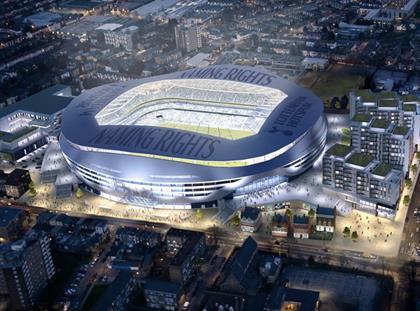


Spurs have played their cards well with the council in recent years, using the threat of exodus to the Olympic Stadium in Stratford to squeeze ever-greater amounts of public subsidy from Haringey Council and the Greater London Authority. In 2011 the council leader Claire Kober stated that no public money would go into the development and Spurs would provide £15-16m in Section 106 funding to redevelop the local area. Nine months later a £17m public funding package was on the table and by January 2012 this was raised to £41.3m with almost all of Spurs’s S106 obligations dropped. Ironically, this is almost exactly the sum that Spurs challenged in the courts as illegal “state aid” when it was offered by Newham Council to West Ham to develop the Olympic Stadium.

Perhaps most cynical, and audacious, is how they tapped into £8.5 million of the £50 million set aside by Boris Johnson to develop areas affected by the August 2011 riots. In doing so, they have effectively cashed in on the social unrest in Tottenham to fund a stadium that will provide huge profits for shareholders and little if any benefit to the surrounding community. The money will essentially go towards funding the improvements to infrastructure surrounding the stadium that Spurs would have had to provide anyway to cope with the extra 20,000-odd fans travelling to the area on match days.


But what is most concerning for local residents is how THFC has shirked its responsibility to provide affordable housing at the same time as it is destroying existing council-owned homes. In its initial plans Spurs had an obligation to provide 100 affordable homes alongside 100 to be sold on the open market. This in itself was pitifully low given the housing crisis in Haringey, but in 2012 the council responded to Spurs’s blackmailing by waiving this requirement as well as the £1.2 million that had been promised to improve local schools. Instead the club has been allowed to build 285 homes that will be sold at market rates. These will be overwhelmingly one and two bedroom flats that will no doubt be snapped up by City workers enjoying the improved overground links to central London, also paid for with public money. This will contribute to pushing up rents in the area which, combined with the benefits cap which has been introduced in Haringey, could force large numbers of low-income families out of their homes.

As a lifelong Spurs fan the slow realization that the club I love is no different to any other large corporation in its parasitism and disrespect for community life has been a painful one. However, as stakeholders in the club and potential punters at the new stadium, I think fans have a responsibility to show solidarity with those who will be affected and potentially displaced by the new development.

Local residents and traders have been mobilising to resist the current wave of gentrification that is sweeping through Tottenham, driven by the stadium redevelopment plans. Our Tottenham are organising a street assembly this Saturday 6th July to say no to the threat of evictions, high rents and loss of community services and demand the improvements that the neighbourhood actually needs.

Follow Joel on Twitter: @JoelJBSharples

Brazil Protests: Implications for 2014

In the first of a series of new blogs looking at broader dynamics in football and social change, Ben Finn analyses the causes and results of the recent protest movement in Brazil


Over 1 million people lined the streets across Brazil on 20th June to protest about a variety of injustices from Dilma Rousseff’s government. A proposed rise in Sao Paulo bus fares was the catalyst, but the reasons behind the demonstrations have flitted between the interconnected motives of anger at poor public services, outrage at the pervasiveness of political corruption and the lavish expenditure on the 2014 World Cup.

At 28 billion rials ($12.6 billion), Brazil’s World Cup is by far the most expensive ever - three times the cost of Germany 2006. Considering the plight of public services across much of the country, it would appear that the protestors have a legitimate grievance.


Writing in the Guardian last week (and having spoken to the BBC a few weeks ago), star striker-turned-Congressman Romario lamented the expense of the tournament. Even if we must take Romario’s comments with a pinch of party political salt, he still makes a number of interesting and valid points. What stood out to me was the tax-free profit of R$4 billion FIFA stands to make from the tournament. Equally, the terrible state into which Brazil’s school system has got itself makes it almost surprising that the protests took so long to erupt. Though falling export demand has lead to dwindling GDP growth and inflationary pressures over the past couple of years, which has undoubtedly jolted awake any previously dormant social tensions.

The fact that the protestors are not affiliated to one of Brazil’s thirty political parties has meant that their message hasn’t been as clear as it might have. What is clear, however, is that most Brazilians are not against the World Cup per se, but they are angry about the lack of ‘legacy’ that the tournament will have. According to The Economist, airports remain mired in the last century and at least five of the host cities have admitted that the bus lanes, metros and monorails they had promised will not be ready before kickoff.

There is, though, a sizable group who are anti-World Cup; their message is outlined in this video (https://www.youtube.com/watch?v=ZApBgNQgKPU). But the sentiment of the video seems clouded to me, it kind of suggests that the World Cup should only be held in rich, developed countries which would be detrimental to world football as a whole in my opinion. Clearly the government has spent way beyond its means but I don’t think confining future World Cups to OECD countries is the answer.

FIFA has, quite rightly, come in for a fair amount of criticism firstly for the extravagance of the plans for the World Cup and secondly for its handling of the resulting protests. Corinthians has blamed FIFA for doubling the cost of its new stadium with its lavish demands.


Moreover, Brazilian officials were apparently “surprised” by the fact that Sepp Blatter high-tailed it out of the country as soon as the unrest erupted. These officials are either extremely polite or unaware of the calibre of man they are dealing with. FIFA has been unsurprisingly silent on the issue but to be fair it is probably not in their interest to get involved in Brazilian domestic affairs.

The fact is that the protests have instigated change: a new constituent assembly to consider political reform; making corruption a felony (previously it was just a misdemeanour); a promise to invest $R50 billion; and increased spending on health and education. This is an undeniably positive outcome that has, according to Rousseff, “strengthened democracy” in Brazil. But it does set a precedent for potential further unrest in twelve months time the next time the world is watching.

It is a shame in a way that what has been a thoroughly entertaining Confederations Cup on the pitch will most probably be remembered for the accompanying protests. My only hope is that, like the British did last summer, the next summer’s World Cup will lift Brazilian spirits and leave them looking forward to – rather than dreading – the Olympics they are staging in 2016.

Next summer Football Beyond Borders will go to Salvador in Brazil to put on the "Legacy Games", a project that aims to bring students from around the world together with local communities to work on long-lasting solutions to social problems in their city. If you would like to find out more about our Brazil 2014 project, please email jreynolds@footballbeyondborders.org

Monday, 3 June 2013

FOOTBALL BEYOND BORDERS STATEMENT 03/06/2013: UNITE AGAINST RACISM

FOOTBALL BEYOND BORDERS STATEMENT 03/06/2013: UNITE AGAINST RACISM

"Football Beyond Borders was set up in 2009 as a response to the aggressive British foreign policy in the Middle East. We objected to the scapegoating of whole communities and the rise of Islamophobia in the UK. As a young group of men we decided to take a stand to try and combat this bloodshed and mutual hostility by engaging with other people who may come from different backgrounds but who shared our love of football and the desire for peace and unity. This has resulted over the past five years in a series of international projects spanning four continents which have tackled discrimination and a sense of powerlessness by championing diversity and giving recognition to others. These aims remain steadfast and are central to the Football Beyond Borders’ ethic and to all the work we do.

Recent events in the UK have seen racial tensions increase, much to our dismay. In response to the shocking shocking incident in Woolwich and the subsequent media hysteria we have decided to take action within both our own local and global communities, rather than passively standing by and watching whilst tensions increase in our society. We will thus be participating in a series of events aimed at uniting people of different communities, faiths and cultures. Firstly, we will be hosting a football tournament called 'Love Football: Hate Racism" on Sunday the 9th of June which will bring Muslims and non-Muslims together in London for a day of football and fun. This will be followed by our participation in a multi-faith football tournament organised by the Faith Regen Foundation on the 22nd of June, where we hope to show solidarity with a broad range of faiths and communities. We have also agreed this week to embark upon a partnership with the United Religions Initiative, who promote grassroots bridge-building between different communities. In doing so we hope to improve our reach and also to learn valuable strategies for achieving our goals. Lastly, this summer we will be taking a mixed-gender football team to the Balkans to try and combat ethnic segregation, gender discrimination and racism. We hope that all these actions will play a part in strengthening inclusion and in diffusing tensions between different communities. 

Let us take a stand AGAINST racism, discrimination and extremism. Instead, let us stand together and SUPPORT diversity, respect and inclusion. Football Beyond Borders aims to act as a vehicle for young people to develop their understanding of the world and their ability to initiate positive social change - as it has already done for those of us who have participated in its projects over the last 5 years. Our experiences have led us to believe that we all have a duty to play our part in carving out a society that we are proud to call home - and we hope that others will join us in our work."

To find out more about our projects and how you can get involved, please email info@footballbeyondborders.org, or follow us on twitter @Fbeyondborders

UPDATE 07/06/2013


Yesterday a vigil was held in Muswell Hill, North London, to show solidarity towards the local Somali community whose Islamic community centre was recently burnt down in a suspected EDL arson attack. One of our members lives less than 5 minutes down the road from the centre and went down to the vigil to represent FBB & show support. 

It was incredibly moving to see how many people of diverse races and religions attended, from the local community and from around London, and spoke out strongly against fascism and racism. You could see how much this all meant to members of the local Somali community, who were visibly moved by the occasion. Let us hope this tragic event helps strengthen the community bonds in the area - this was certainly a very good start!

Many of the calls echoed the words of our recent statement above.

The FBB ethos is all about bringing communities together, so it was great to see that philosophy in action at the Vigil, and to play some football with kids from the local community in the park afterwards, in true FBB fashion! :)

For reports on the vigil, see: 


Monday, 5 March 2012

Reflection on Balata Camp

This was my second experience on a SOAS Football Beyond Borders project, having been to West Africa last year, but I knew that going to Egypt, Palestine and Jordan would be a very big test for everyone. Drawing on our shared passion for football and for the strong ideals that united us, we all strived to do something positive and genuine for this project.

Of all my experiences in the Middle East, one stands out to me the most. During our stay in the Yafa Cultural Center, located within the Balata Refugee camp in the district of Nablus, we came to meet many interesting people, both young and old. Our days consisted of different activities with the people there, but at least once a day we were able to play either an organized match on a local pitch or an informal pick-up game in the stony alleyways of Balata.

On one cool evening, as the sun was just setting, Sam and I decided to stroll the camp and meet people. Never forgetting to leave without a football, we dribbled along casually, which inevitably led to us into a challenge to play by a group of young Palestinian kids. Sam and I eagerly accepted, splitting ourselves up and letting the boys determine the right balance for teams. One of the boys, definitely not on the shy side, nicked the ball and quickly began the match. Having spent my past summers as youth football coach back in the States, I was inspired by how ‘at home’ I felt just being able to play football amongst kids – though I was slightly discouraged after being nut-megged once or twice.


The meaning that I drew from the experience was inspired by the ability of everyone who was playing to momentarily transcend not only the boundaries between us, but also the sense of plight that overcasts the camp. The children were undoubtedly politically conscious, and I can’t begin to fathom what life must be like living under occupation in a refugee camp, but for what it’s worth, the chance to experience moments of happiness is something not to overlook.

While the political element to the conflict in Palestine and Israel is impossible to avoid, all considerations of conflict and difference seemed distant next to the enjoyment of the game in that moment. In light of the recent turmoil and horrendous violence that has plagued the Middle East, I recognize and accept that some grassroots efforts, such as our recent project, won’t have the necessary impact required to end suffering on the ground. However, one thing that sustains grassroots projects remains true, and that is the need to foster hope and to resist suffering. Embracing humanity and hope is as important as it has ever been, and my experience in the Middle East has only underscored that for me.

The Conflict

When I was at school, we had one lesson about the Israel-Palestine conflict but as it was just one of the conflicts we learnt about no one really thought much about it. We certainly didn't consider it a conflict that was relevant and still ongoing.

Apart from that one lesson, I didn't hear much about Israel and Palestine until I joined the SOAS football team in my second year at university. I went from not hearing about it at all to hearing about it all the time. However I continued to ignore their persistent and somewhat irritating insights and opinions on the conflict as I reasoned that as there are so many problems in the world, it hardly seems justified to harp on about just one of them.

Indeed I suppose I deliberately decided not to learn anything about Israel and Palestine, as it seemed such a 'commercial' mainstream conflict to follow. This continued up until I heard that we were going to actually go and visit both of the countries last September. Even then though, I still decided not to learn or read about the history and reasons for the ongoing problems. This was in large part because I felt that the image that I was presented was more often than not that the Palestinians were a marginalised and abused people, facing incredible oppression. Hence I decided that rather than rely on the media for supposedly 'trusted' information and an unbiased account, that the best option would be to see things through my own eyes and form my own opinion.

Before we had even entered Israel, the dogmatic questioning faced by Omar and Jo (the Lebos on the team) had not entirely endeared me to the border guards. However, in reality the border guards were just doing their jobs and due to the tensions, they were justified in doing their job dutifully albeit to the extreme. When we arrived at the bus stop from where we would get a bus to Tel Aviv, the refusal of the locals to talk to Jo and Omar when they asked them questions disgusted me and unfortunately only hinted of things to come. Throughout our brief time in Israel, I felt uncomfortable and uneasy as Israeli Defence Force soldiers were everywhere. The interviews that Jasper and Matt captured with Israelis in Jerusalem demonstrated some despicable viewpoints, which disgusted me. Presumably however, some similar views must also be held by Palestinians. Indeed since returning from the football tour, I have joined up to some Palestinian groups on the internet and at times their vehemance for the Israelis and opinions also shock me.

It is only through these online groups that I have experienced outright hatred for the Israelis. Indeed when we were in Palestine I was amazed at the fact that everyone we met preached peace, a desire for an end to the conflict and oppression and accepted an Israeli state. It was in Palestine that I realised the daily oppression they must face whether it be from the numerous check points, the threat of settlers coming to town centres and the visible settlements at strategic points built on Palestinian land. The wall also seems a bit oppressive.

The Palestinian people really impressed me with their outlook on life and their desire to control their own destiny without Israel controlling them and their movements. Since the tour, I have tried to spread the portrayal of the Palestinian people that I experienced that comes from first-hand experience and not from possibly biased media outlets. This has been somewhat hard though as I have been living in Zanzibar where only a very small minority of the people I have met have even heard of Palestine.

My greatest success so far has been whilst I was in Zanzibar studying Swahili. I had training every day with a team in the Premier League, and before every match we would go and have lunch together. All of the players always ordered Coke, and would offer me a Coke as well. When I refused, they were surprised and asked me why I didn't want one. I proceeded to tell them that by buying Coca-Cola products they support the Israeli state. Unfortunately, however, they had never heard of Israel and Palestine. I therefore embarked on a long explanation about apartheid South Africa and the politics of racism. After an epic 15-minute monologue in Swahili, I concluded '...and that’s why I don't drink Coca-Cola products.' After an unimpressed short silence, I added 'Also - its bad for you before playing football'. Although people kept on drinking their Cokes, this apparently had the desired effect, as the next week the players were only allowed water and juice before the match due to a mysterious 'doctor' concluding that Coke is bad for you before playing football!

While I was originally skeptical about the Palestinian movement, the only conclusion I could reach from what we experienced is that the peaceful movement should be supported to try and bring an end to the Israeli oppression.